
Retail UX program
Client: Google · Role Lead UX Designer · Launched 2019-2024·
A five-year program to make retail brands competitive on mobile — and a case study in why clients are often wrong about their own problem.
Google funded a tri-party Retail UX program with Deloitte and partner brands (J.Crew, etc.) to lift mobile conversion across the shopping ecosystem. I led UX across the program for five years, setting the operating model between the three organizations and driving the research, design, and strategy that defined each wave's priorities.
Below are brands I have worked with @Google and impact metrics.

Designing Processes
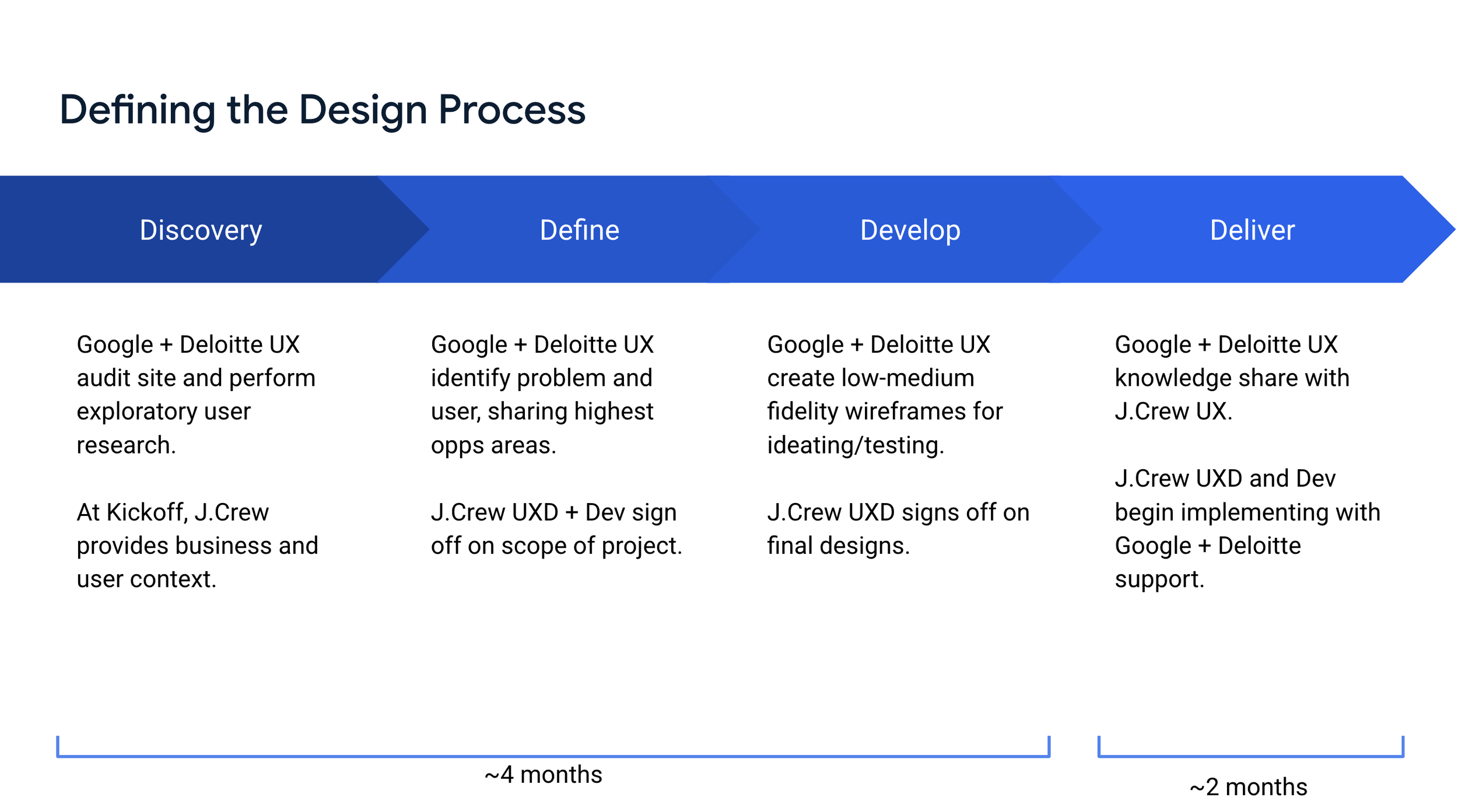
A Google–agency–client partnership has no default playbook. Deloitte, J.Crew, and Google had different definitions of done, different research methods, and tolerances for risk. I defined how the three teams worked together: what Google owned (strategy and research direction), what Deloitte owned (execution and client-side delivery), and what the brand owned (prioritization and launch). That structure became the template for subsequent waves and brand partners.
Influencing a pivot

J.Crew came in convinced their problem was findability — revenue was dropping, mobile conversion was low, and leadership believed users couldn't locate products.
I wasn't convinced. I worked with the Deloitte UXR to run exploratory user testing before committing the team. The research was unambiguous: users found the products but failed in the lower funnel — add-to-cart, cart, and checkout.
To pivot, I built a qual/quant narrative with Deloitte that made the lower-funnel evidence undeniable, then walked J.Crew's design, product, and engineering leads through it as a strategic redirect rather than a contradiction. The rescope was approved by all teams.


Iterations
Here were the initial wireframes I helped created at low-fidelity.

Here are higher fidelity wireframes I helped iterate after integrating insights from our user tests.

What shipped

The redesigned lower-funnel flow introduced always-enabled CTAs and clear error-state guidance — users were never blocked, always prompted toward the next decision (size selection being the most common failure point).
The patterns(error handling, modals) were integrated into the J.Crew design system and reused across subsequent flows.
Impact

Learnings
Clients work with you for execution and need you for diagnosis. The hardest and highest-value work in a multi-org program isn't the design — it's having enough evidence and enough conviction to pivot a committed roadmap when the research says it's pointed at the wrong problem.
Now, I look to test the premise first, then design for the right problem.